Product Performance Analysis
Product performance analysis measures how well your products generate revenue, retain customers, and drive business growth through metrics like sales velocity, customer lifetime value, and conversion rates. Whether you're struggling to benchmark your performance against industry standards, lacking a systematic analysis template, or unsure how to improve declining product metrics, this comprehensive guide provides the frameworks and strategies to optimize your product performance and maximize profitability.
What is Product Performance Analysis?
Product Performance Analysis is the systematic evaluation of how individual products or product lines contribute to a company's overall revenue, profitability, and strategic objectives. This analysis examines key metrics like sales volume, revenue growth, profit margins, and market share to understand which products are driving business success and which may need attention. By tracking these performance indicators over time, businesses can identify trends, seasonal patterns, and opportunities for optimization.
This analysis is crucial for informing strategic decisions about product development, pricing strategies, inventory management, and resource allocation. Companies use product performance analysis to determine which products to promote, discontinue, or modify, helping them maximize return on investment and respond effectively to market demands. The insights gained directly impact decisions about marketing budgets, production planning, and expansion into new markets.
Strong product performance typically indicates high customer demand, effective positioning, and healthy profit margins, while poor performance may signal pricing issues, market saturation, or the need for product improvements. Product Performance Analysis is closely interconnected with metrics like Average Order Value, Revenue per Customer, Inventory Turnover Rate, and Cross-sell Analysis, as these metrics together provide a comprehensive view of product success and customer behavior patterns.
How to do Product Performance Analysis?
Product Performance Analysis involves systematically evaluating your product portfolio to identify top performers, underperformers, and optimization opportunities. This multi-dimensional analysis examines revenue contribution, profitability margins, customer adoption patterns, and market trends to guide strategic product decisions.
Approach: Step 1: Collect comprehensive product data including sales revenue, units sold, costs, customer segments, and time periods Step 2: Calculate key performance indicators like revenue per product, profit margins, growth rates, and market share Step 3: Segment analysis by customer demographics, geographic regions, sales channels, and time periods to identify patterns Step 4: Compare performance against benchmarks, competitors, and internal targets to prioritize action items
Worked Example
Consider an e-commerce retailer analyzing their electronics category. They gather six months of data for three product lines: smartphones ($2.1M revenue, 15% margin), laptops ($1.8M revenue, 22% margin), and accessories ($800K revenue, 35% margin).
The analysis reveals smartphones generate highest revenue but lowest profitability, while accessories show strong margins despite lower volume. Breaking down by customer segment, they discover smartphones drive new customer acquisition (60% first-time buyers) while accessories have highest repeat purchase rates (45% returning customers). Geographic analysis shows laptops outperform in urban markets but lag in rural areas.
These insights suggest focusing marketing spend on smartphone acquisition campaigns, expanding accessory inventory for existing customers, and developing targeted laptop promotions for rural markets.
Variants
Time-based analysis compares performance across different periods (monthly, quarterly, seasonal) to identify trends and cyclical patterns. Channel-specific analysis evaluates product performance across sales channels (online, retail, wholesale) to optimize distribution strategies.
Customer lifecycle analysis examines how product performance varies by customer tenure, enabling targeted cross-selling strategies. Competitive benchmarking positions your products against market alternatives using external data sources.
Common Mistakes
Ignoring profitability for revenue leads to promoting high-volume, low-margin products that hurt overall business performance. Always analyze both metrics together to make balanced decisions.
Using insufficient time windows can misrepresent performance due to seasonal fluctuations or temporary market conditions. Ensure your analysis spans multiple business cycles for reliable insights.
Overlooking cannibalization effects occurs when new product launches impact existing product sales. Account for portfolio interactions rather than analyzing products in isolation.
Stop Reading About Product Metrics. Start Analyzing Them.
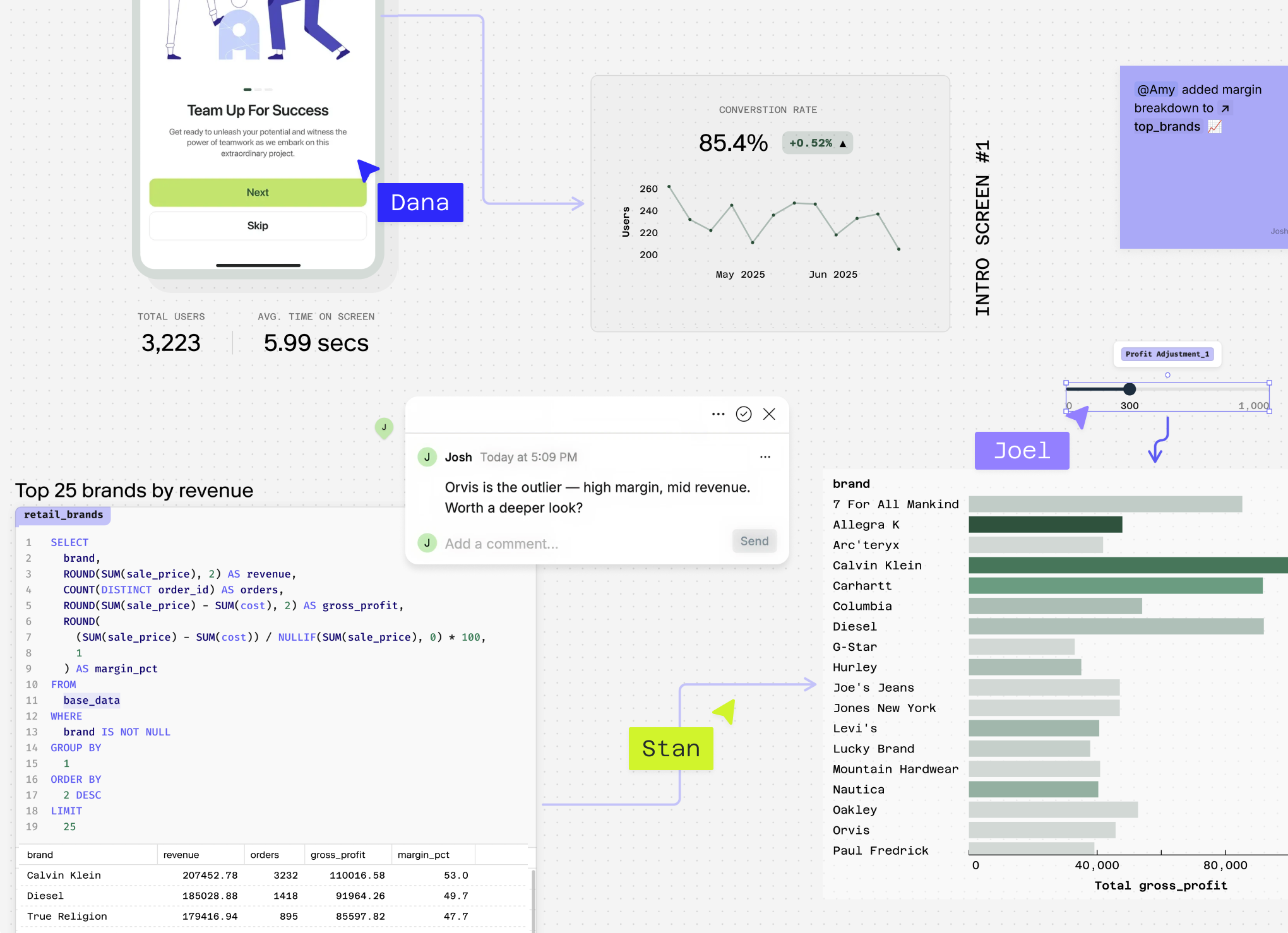
Connect your data warehouse to Count's AI-powered canvas and turn product performance questions into insights—with your team, in real-time, not weeks later.
What makes a good Product Performance Analysis?
While it's natural to want benchmarks for product performance analysis, context is everything. Industry benchmarks should serve as guideposts to inform your strategic thinking, not rigid targets that dictate every decision.
Product Performance Benchmarks by Industry and Stage
| Industry | Stage | Business Model | Revenue Growth Rate | Gross Margin | Customer Acquisition Cost Payback |
|---|---|---|---|---|---|
| SaaS | Early-stage | B2B Self-serve | 100-300% | 70-85% | 5-12 months |
| SaaS | Growth | B2B Enterprise | 40-100% | 75-90% | 12-18 months |
| SaaS | Mature | B2B Enterprise | 20-40% | 80-95% | 6-12 months |
| Ecommerce | Early-stage | B2C | 50-200% | 20-40% | 1-3 months |
| Ecommerce | Growth | B2C | 25-75% | 30-50% | 1-4 months |
| Ecommerce | Mature | B2C | 10-30% | 40-60% | 1-2 months |
| Subscription Media | Growth | B2C | 30-80% | 60-80% | 3-8 months |
| Fintech | Growth | B2B | 50-150% | 40-70% | 6-15 months |
Sources: OpenView SaaS Benchmarks, industry estimates
Understanding Benchmark Context
These benchmarks provide valuable reference points to gauge whether your product performance metrics are within reasonable ranges for your industry and stage. However, remember that exceptional performance often comes from understanding the unique dynamics of your specific market, customer base, and competitive landscape rather than simply hitting industry averages.
Product performance metrics exist in constant tension with each other. As you optimize one area, you may see trade-offs in another. For instance, improving gross margins might require raising prices, which could impact customer acquisition rates. Similarly, expanding into premium market segments might boost average contract values while simultaneously increasing customer acquisition costs.
The Interconnected Nature of Performance Metrics
Consider how Revenue per Customer interacts with Repeat Purchase Rate. If you're seeing strong revenue per customer growth but declining repeat purchases, you might be successfully moving upmarket to higher-value customers who have longer, more complex buying cycles. This isn't necessarily negative—it's a strategic shift that requires adjusting your entire performance framework, from sales forecasting to customer success strategies.
The key is analyzing your product performance holistically, using benchmarks as one data point among many rather than the sole measure of success.
Why is my product performance declining?
When your product performance analysis reveals declining metrics, several root causes could be driving the downturn. Here's how to diagnose what's happening:
Market Saturation and Increased Competition Look for declining market share, reduced Average Order Value, and longer sales cycles. If competitors are capturing your customers or your pricing power is eroding, you'll see revenue per product drop even as unit sales remain stable. This often cascades into reduced Revenue per Customer and lower overall profitability.
Product-Market Fit Deterioration Watch for declining Repeat Purchase Rate and increasing customer acquisition costs. When products no longer meet evolving customer needs, you'll see one-time purchases without loyalty building. This signals that while initial sales might look healthy, long-term performance will suffer as customer lifetime value plummets.
Inventory and Supply Chain Issues Monitor Inventory Turnover Rate alongside stockout frequency. Poor inventory management creates a vicious cycle: stockouts lose sales and customer trust, while overstock ties up capital and increases carrying costs. Both scenarios directly impact product profitability and performance metrics.
Cross-selling and Bundling Failures Examine your Cross-sell Analysis for declining attachment rates. When complementary products aren't selling together, you're missing revenue opportunities and reducing overall basket value. This often indicates poor product positioning or inadequate sales processes.
Pricing Strategy Misalignment Look for margin compression despite stable unit sales, or volume drops following price changes. Misaligned pricing either leaves money on the table or prices out your target market, directly impacting how to increase product revenue performance.
The key to improvement lies in systematic diagnosis followed by targeted optimization strategies.
How to improve product performance analysis
Segment Your Analysis by Customer Cohorts Instead of analyzing aggregate product performance, break down metrics by customer acquisition date, demographics, or behavior patterns. This reveals whether declining performance stems from specific customer segments or affects your entire base. Use cohort analysis to isolate whether newer customers behave differently than established ones, helping you understand if the issue is product-market fit or customer acquisition quality.
Implement Dynamic Pricing and Bundling Strategies Combat competitive pressure and market saturation by testing different pricing models and product combinations. A/B test price points, bundle complementary products, or introduce tiered offerings. Monitor how these changes affect both Revenue per Customer and Cross-sell Analysis metrics to validate which strategies drive sustainable performance improvements.
Optimize Your Product Mix Based on Data Trends Use your existing sales data to identify seasonal patterns, declining product lifecycles, and emerging opportunities. Analyze Inventory Turnover Rate alongside sales velocity to phase out underperforming products and double down on high-performers. This data-driven approach prevents you from guessing which products to prioritize or discontinue.
Focus on Customer Retention and Repeat Purchases Address performance decline by improving Repeat Purchase Rate through targeted retention campaigns. Analyze purchase frequency patterns to identify at-risk customers and implement re-engagement strategies. Often, declining product performance reflects customer churn rather than product issues—your data will reveal which is the primary driver.
Leverage Integration-Specific Insights Whether you're using Salesforce or Shopify data, platform-specific metrics can reveal unique optimization opportunities. Sales pipeline data might show longer conversion cycles, while e-commerce data could highlight cart abandonment patterns affecting Average Order Value.
Run your Product Performance Analysis instantly
Stop calculating Product Performance Analysis in spreadsheets and start getting actionable insights in seconds. Connect your data source and ask Count to automatically calculate, segment, and diagnose your product performance metrics with AI-powered analysis that identifies trends, benchmarks performance, and uncovers optimization opportunities across your entire product portfolio.
Explore related metrics
Average Order Value
Track AOV alongside product performance to identify which products drive higher transaction values and optimize your product mix for revenue maximization.
Inventory Turnover Rate
Monitor inventory turnover to ensure your best-performing products don't face stockouts while identifying slow-moving items that need promotional support or discontinuation.
Cross-sell Analysis
Analyze cross-sell patterns to understand which products naturally complement your top performers and create bundling strategies that boost overall product portfolio revenue.
Revenue per Customer
Measure revenue per customer to determine whether strong product performance translates into higher customer lifetime value and identify products that attract high-value buyers.
Repeat Purchase Rate
Track repeat purchase rates to validate whether your top-performing products create lasting customer relationships or just generate one-time sales spikes.
Stop Reading About Product Metrics. Start Analyzing Them.
Connect your data warehouse to Count's AI-powered canvas and turn product performance questions into insights—with your team, in real-time, not weeks later.